
Menu
UPSC Preliminary Examination Syllabus
1. Paper I – (200 marks)
- • Current Events of National and International Importance.
• History of India and Indian National Movement.
• Indian and World Geography-Physical, Social, Economic Geography of India and the World.
• Indian Polity and Governance-Constitution, Political System, Panchayati Raj, Public Policy, Rights Issues, etc.
• Economic and Social Development-Sustainable Development, Poverty, Inclusion, Demographics, Social Sector Initiatives, etc.
• General issues on Environmental ecology, Bio-diversity and Climate Change – that do not require subject specialization.
• General Science.
2. Paper II – (200 marks)
- • Comprehension; Interpersonal Skills including Communication Skills.
• Logical Reasoning and Analytical Ability.
• Decision Making and Problem Solving.
• General Mental Ability.
• Basic Numeracy (Numbers and their Relations, Orders of Magnitude, etc.) (Class X level).
• Data Interpretation (charts, graphs, tables, data sufficiency etc. — Class X level). - Note 1: Paper-II of the Civil Services (Preliminary) Examination will be a qualifying paper with minimum qualifying marks fixed at 33%.
Note 2: The questions will be of multiple choice, objective type.
Strategy
- Preliminary Exam, the very initial round of UPSC CSE Examination, poses a plethora of challenges to the aspirants. Even the experienced candidates fail to make their mark in this round of examination.
- Thus, the fascinating and challenging nature of the exam leaves every aspirant with a lot of queries which goes unanswered.
- Here are some tips for students to improve their Prelims scores and face the odds in examination with grit and confidence:
How to stay motivated to conquer Prelims?
- “Do not delay. Get up, rise, run towards your goals!”- The voice boomed as the video came to a close. She was super motivated…but wait, not for long- just until the afternoon. Solace then came through her books of motivational sayings. In the evening, she needed to refuel her motivation again: so out came the phone with her friend, philosopher & guide- QCR. Like a car that needed periodic refuelling – she too needed regular motivation from her mentor, YouTube, books, articles. But it was always back to square one the next day!
- Can you relate? The quest for motivation which we constantly seek from external sources? Why is motivation important? And how do we manage to stay in a constant state of being motivated to seize the day? Let’s talk about it & share our views. Please do leave a comment & tell us how you do it- we’d love to learn!
- Dale Beach defines motivation as “the willingness to expand energy to achieve a goal or a Reward”. Remember the first inkling you had of this dream? The rush of excitement, the fear of the unknown, you may not have known what you’re getting into completely then. When you decided to take the civil services exams – you had a solid reason: to serve the people, to bring about a positive change in the society. You had internal motivation to make this choice.
- But has that strong motivation slowly made way for fear of failure, stress & under-confidence? We’d like to assure you that it is absolutely normal- you’re not alone. But it is important for you to learn to stop being completely dependent on external sources for motivation. While they can help, they shouldn’t be the main fountain of motivation. They should supplement your strong internal motivation to accomplish any task in life.
- Always remember that you are your own biggest cheerleader. You embarked on this uncertain path due to a strong & noble reason. Motivation sustains & grows when we see progress. Let’s say you decided to solve our Prelims 75 day plan today & you scored a little less. But you decided to persevere & learn from your mistakes. A week later, you’d see an incremental improvement in your score. This would “motivate” you to continue putting in the work because you know that you will see progress eventually.
- The oft-repeated quote by Zig Ziglar states that “People often say that motivation doesn’t last. Well, neither does bathing -that’s why we recommend it daily.” Thus, make staying motivated a subconscious habit, your default attitude. Everyday acquire & retain that enthusiasm to accomplish your goals as a matter of duty (to yourself, your family, your society).
- Write down your goal now and stick it on your table/wall/board: let it fuel you every single day. You want an AIR 1? Write it in capital letters. See it every day whenever you feel like giving up. Tell yourself that you will accomplish it with your dedication & efforts. Note down your progress, however small, every single day. You got a 90 today & a 90.25 tomorrow? That is progress (seriously, so many have lost out on their dream by 0.1 marks too).
- Find that fire within yourself- to stay consistent & achieve your goals. Every time you feel like turning your back on your targets for the day, close your eyes, take a deep breath & remember why you started.
- Until next time!
The Journey to Prelims: through Ups & Downs
- Monday was a ray of sunshine- she felt super optimistic about the exam. On Tuesday, the clouds had started to gather (did not-so-well in a mock). Wednesday there was a drizzle (from her eyes?). Thursday, it grew into a full-fledged thunderstorm. Friday, there was calm after the storm. Saturday, the sun had started to peep in from behind the clouds. And on Sunday, there was that much needed bright sunshine (her mock went really well). No, we weren’t describing the weather for the week but the various moods that she went through while preparing for the exam.
- Sounds familiar? The ups & downs on a regular basis? Bright & sunny on one day & gloomy & despondent on the next? The fear, stress & uncertainty that envelopes one? So how does one maintain equanimity through this trying process? We’ll share a few tips.
- Firstly, BE MINDFUL. This enables you to focus on the task at hand. On the NOW. Do not think about the past (multiple attempts, bad mock, 1000 other issues you may have) or the future (“What if I pass? What if I fail?”). The present is like a seed, from which the future sprouts. What are you nourishing it with? Worry, fear or positivity? It is YOUR CHOICE- YOU get to choose (See the immense power YOU have?)
- You must also learn to CONTROL ONLY WHAT YOU CAN– Can you alter your past? Or are you an accurate astrologer (do they exist?) to predict your future? If you’re wise- you’ll know that the past, future & even present outcomes are not within your control. So what is it that you can control a 100%? YOUR EFFORTS. That’s it. So do your part every day. Worrying about the rest is detrimental to your best.
- Focusing on what’s under your control empowers you to LET GO– Of all the worries (“Will I clear this year? How tough will prelims be? I’m getting old! Unemployed! Look at all my friends enjoying their lives while I’m stuck in my room glued to screen/books!”)- Don’t you see? They’re all made up in your mind – things that haven’t yet happened or things that you can’t control. Let it go. There’s so much FREEDOM in letting go of things/people/memories that don’t do you any good. It makes you feel powerful & light. If you worry about something- replace it with a positive thought. Don’t carry around the burden of worries (The numerous books are burden enough right?). Travel light.
- The most important thing to let go of are the unwelcome guests- the barrage of negative thoughts (and negative people). You must replace them with positive thoughts like GRATITUDE. Being thankful infuses tremendous positivity into our lives. It’s the glass half-full mindset (rather than the glass half-empty). Be thankful for waking up every day, having access to the basic necessities, digital connectivity (you’re reading this article), etc. if you look around – you’ll find that you’re blessed with so much.
- Be positive. Don’t get bogged down by the transient waves of the day. After every trough, there’s a crest. Your duty is to do YOUR best through them all. Remember, this too shall pass. We believe in you. But more importantly, you have to believe in yourself. Keep going.
- Until next time!
Flop to plan, plan to Flop (Prelims)
- The sound of paper being ripped and crushed became her choice of background music at night. One could also hear the other accompanying instruments like guilt, regret, frustration, shame etc albeit faintly. No, there wasn’t a live orchestra in the background while she studied (it would be cool though right? Like in the movies? ) They were her timetables – which she would sit & rip apart sadly every single night. Well-crafted, detailed, ambitious ones. The only problem with them? They aimed too high- 18 to 19 hours in a day with 10000 targets – which of-course she could never implement fully. She’d go to sleep drafting a new one for the mythical “Tomorrow”- but the cycle repeated everyday.
- Can you relate? The over-ambitious targets we set for ourselves, the burden of unfinished targets for the day, the stress & guilt associated with it, the procrastination when we tell ourselves “I’ll complete it tomorrow!” Sometimes we choose to go with the flow & make ad-hoc plans to study with no set goal in mind- that too can be detrimental. We both know that planning is essential but what is the most optimal way to go about it? How do we chalk out timetables & STICK TO THEM? We’ll share a few tips- Let’s start! (Please share your tips too in the comments! We love learning from you’ll).
- 1. BE PRACTICAL: In the following aspects
- • SETTING TARGETS: for the day/week/month. Prioritize. By going through PYQs we can decipher the topics that carry the most weightage. Do them first. Give adequate time for learning & revision. Do not try to sprint through topics. Absorb the concepts well. For example, if we are studying from Laxmikanth, we should start with the most important chapters & we must give it adequate time- you cannot aim to finish revision of the entire book in half a day. It’s no good checking things off the timetable if you do not focus, absorb and understand what you’re learning.
• PUTTING IN THE HOURS: Have you read (or been shown by your parents, relatives etc) all those cool newspaper articles where kids studied for 20 hours a day & ended up topping various exams… they sound great. May even inspire us to emulate them for a bit. But we’re all different. It’s not about the number of hours we’re sitting at a table for (and eventually staring at various distractions or the ceiling?) No. Effective and efficient study is about how focused we are while studying. It can be 4hrs or 8 hrs. With deep focus we can accomplish faster & betterwhat would have taken longer otherwise. FOCUS ON the QUALITY, not just QUANTITY. - 2. SET OR PICK A SCHEDULE: Keeping the above 2 points in mind, frame your own timetable. Stick to anything that suits you. Do not try and emulate others’ methodologies. Analyze yourself, your strengths & weaknesses. You are unique and you know best what works for you.
- 3. BE ACCOUNTABLE: to a mentor, parents, a study partner, to your peers in our comment section, but most importantly to yourself. This is your journey. Taking this exam was your choice (we hope). Therefore, be answerable to yourself about your actions for the day. Did they help in bringing you a bit closer to your goal? Did you improve from yesterday & learn from your previous mistakes?
- 4. BE ADAPTABLE: We’re all human. Perfection is not possible right? So if you miss a target for the day, it’s ok. Do not stress. Always compliment yourself for what you did achieve for the day. You must be your own biggest cheerleader! Don’t aim for perfection, aim for action- make mistakes along the way but just keep doing your work. Strive to improve every single day.
- 5. THE 100% RULE: show 100% commitment to your aims & goals. Give it your all. Do not hesitate on investing yourself fully into your goal. Be 100% in it to win it.
- So the aspirant who made crazy ambitious timetables… what happened to her? Well, she took a step back from the chaos & realization dawned, learnt from her mistakes, and stopped trying to emulate every topper from every talk she heard or article she read. She analyzed herself, her strengths & weaknesses and chose a plan that was best suited for her. Cut to the present: She’s calm, optimistic & is well on her way to achieve her big (& small) goals. The lesson? You do you! Always!
- How about you? Are you planning pragmatically? Are you striving for improvements everyday? Are you in it to win it?
- Charles Bukowski had written: “If you’re going to try, go all the way. Otherwise, don’t even start. If you’re going to try, go all the way. There is no other feeling like that.”
- So will you go all the way?
- PS: You’re doing great! Keep going.
- Until next time!
Face Prelims – Don’t let it Rattle you!
- The clock struck 1…”I must sleep now” she thought to herself and pulled the blanket over her face- maybe that would help her close her eyes? But underneath the warm embrace the blanket offered, she was wide awake with anxious thoughts swirling in her head-“Did I revise that last chapter of polity? What was that river flowing through that state? Is that species endangered or critically endangered? What was that soil rich in? OMG I don’t remember ANYTHING! Maybe I should wake up and study. But sleep? What if I can’t focus during the exam? Let me sleep!”….that internal dialogue continued well into the wee hours. Sunday had dawned- Prelims was here to greet her like an old friend (or foe? Definitely her foe- It was her 2/3/4/5/6th attempt after all).
- Does this scenario seem familiar to you? The panic, the stress (especially for those of you’ll who’ve given many attempts- we see & feel you!), the feeling of SO much riding on 2 papers. It is not easy. Kudos to you for your grit & perseverance. This article isn’t going to give you tips and tricks to clear prelims(there are MANY of those last minute hacks on YouTube- most don’t work- we’re saying it with experience). Instead, we’ll talk about the attitude and mindset needed to face this seemingly insurmountable mountain (we’re sure you will have great suggestions too- do leave your valuable tips in the comments!). Let’s start!
- 1. *drum roll for the oft-repeated suggestion*: BE CALM. We’ve heard this a million times, right? But how do we remain calm like Buddha amidst so much uncertainty (people say U stands for unpredictable). We’ll give our 2 cents on how we learnt to remain calm through trials & tribulations.
- • PRACTICE: You know, they’re not lying when they say “Practice makes perfect”. It’s not just about writing mocks (especially not online!). From now on, every Sunday think it’s THE prelims exam. Sleep early (Actually sleep comes easily on other days, are we right?), print out any mock Question paper & OMR sheets. And attempt the paper with the black ball point pen in the same time slots as the real prelims. Do it with all the disturbances possible- to train your mind to focus only on the paper. It helps in case you get a noisy centre or an invigilator who talks too much. So START NOW, it’s not late at all. June 5th will be just another exam on a Sunday for you.
- 2. STOP BEATING YOURSELF UP – over the material you didn’t complete reading. Raise your hand(or drop a comment & educate your peers) if you have 10000000 booklets, mock tests, “100% guarantee on clearing prelims or money back” course materials, infinite bookmarked articles, YouTube videos/playlists on tricks & tips. Do not become a collector of materials (We both know you’ll be donating it for recycling or deleting them). So no, you don’t need to read all that. How should you counter the supply glut of materials?
- • STICK TO THE BASICS: Heard of NCERTS? (we know you have).Read them, re-read them, revise them a minimum of 3 times at least? Please? Trust us, you won’t feel miserable if you are unable to answer some random question but you will feel sad if you somehow forget a basic concept & fail to answer a simple conceptual question from the NCERTS. So every time you see those shiny new objects- the freshly photocopied material or newly uploaded PDFs- on “the 1000 most important topics for prelims” – resist the temptation and RUN AWAY (physically & digitally).
- 3. GET A FEEL OF THE REAL EXAM: It’s not just about attempting mocks of various coaching institutes. Nobody can emulate the way UPSC sets the question papers. Therefore, attempt PREVIOUS YEAR QUESTION PAPERS (GS+CSAT). This will give you an idea about the language used, format, option elimination techniques and other snippets of wisdom. Read about the various answer choices too. Familiarity helps & familiarity comes with deliberate practice.
- 4. BE KIND TO YOURSELF: Give it your best. Study & revise the basics, solve the PYQs, do not neglect CSAT. Tell yourself that you are doing your best every single day. Didn’t study much today? It’s alright. Wake up tomorrow and give it your 100%. No time for regrets. Do not compare yourself to anyone else (your fellow aspirants, cousins, friends who are probably working, earning, travelling while you sit in your room or library studying or if you’re managing both work and study & have no time left for anything else). Life is not a competition. We all choose different paths. Appreciate yourself & be your own cheerleader.
- 5. THE EXAM IS NOT LIFE: You know all that pressure you put over yourself? About multiple attempts, being unemployed, the hydra-headed monster of self-doubt that plagues you-if you’ll clear it or invest another year…the thoughts of “what will people say?” Banish such thoughts. Tell yourself that “It’s just an exam”. It’s not bigger than your happiness & well-being. It really isn’t. Take regular breaks to recharge, relax, and talk to your parents or friends/mentors who encourage you. But most importantly, talk to the person staring back at you in the mirror & tell them “Hey, you’re doing your best. That’s all that matters. Keep going.”
- Forget the past or how you didn’t study last week or how many attempts you’ve given, focus on the NOW in your preparation.
- Until next time!
- How to go about the UPSC Prelims paper to finish it in time?
- Finishing the paper before time is critical so that you can revise the paper and correct any apparent mistakes. There is no one best approach to finish the paper, but here are some ways in which you can increase the pace and efficiency with which you attend the paper.
- Complete the paper in MULTIPLE rounds, always!
- Many aspirants fail to complete the paper on time because they get stuck on a few confusing questions which eat away much of their time. To avoid this, complete the paper in at least FOUR rounds.
- • In the first round, SCAN and swiftly READ the paper. Doing so makes you familiar with the question paper as a whole even before you begin to attempt it. This fires up your brain as it start preparing itself to face various areas of the paper. This is really important, do not skip this step! Also, do not feel worried at this point if there are several unfamiliar questions in this paper. Every year the paper is such that there are many unfamiliar questions – nearly every aspirant feels the same way. Spend no more than 5 minutes in going through the paper in the first round.
• In the second round, attempt only those questions that are easy, straightforward or that you can solve in one go. Doing this boosts your confidence significantly, releases a lot of pressure and prepares you to tackle harder questions in the paper. Try solving 35-45 questions in this round. In most cases, you should not take more than 40-50 minutes to complete this round.
• In the third round, attempt questions of medium difficulty level that you had some confusion about. (Do not attempt hard or very hard questions at this point.) Try to eliminate options using your background knowledge, common sense and smart elimination techniques. (We will cover an article about this kind of elimination soon.) You will see that about 25-35 questions can be easily solved this way and that you are very near to completing a major chunk of the paper. This round should not take more than 30 minutes. By now, you would have solved more than 60-80 questions.
• In the fourth round, take a dig at hard and very hard questions. Do not indulge in blind guessing, rather make careful, informed and intelligent guesses and see if you can mark answers reasonably. You will find that 10-15 questions can be solved this way. Also, many questions that first appeared hard will now appear easier because your confidence increases tremendously after solving a major chunk of the paper. Instead, if you had solved these questions in the very first round, you would not only lost a lot of time but also lost confidence with respect to the paper. Spend no more than 15-20 minutes in this round. - By now, you would have spent anywhere around 90-100 minutes and solved about 70-95 questions with 20 minutes or so to spare. Try REVISING the paper at this point and see if you want to update any of the answers you have given so far. Also, verify the OMR sheet once to ensure that all the answers are correctly punched in.
- During rounds one to four, it is a good idea to star mark questions that you are a bit unsure about so that you can attend them in the very final revision round.
Attend as many mocks as possible
- More and more practice also makes you better at managing exam related stress and avoiding last minute rush that often leads to costly mistakes.
- We keep mentioning this, but the more mocks you attend in exam like conditions, the better you get at time management in the exam.
- If you follow the approach above, you will not only complete the paper well ahead of time, but also be able to revise it well and address any potential mistakes. In the end, it all boils down to execution, so make sure that you do it well. Your scores will definitely improve!
Scoring low in mock tests, what to do?
- This is a common concern. Testimonials tell us that even toppers used to score 50-60 in mock tests but sailed comfortably in UPSC Prelims.
- There are several reasons why you may score less in mocks. Before you take any further steps to rectify your mistakes, it is important to identify the reasons behind the same: are there genuine lapses in your preparation or are your scores low naturally just like every other aspirant?
- 1. Scale of coverage, toughness and relative scores
- An entire mock test series may cover anywhere from 2000-4000 questions spanning across a vast array of topics. Mock tests also cover the syllabus in a lot of detail, as a result of which it is not unusual to find a lot of unheard questions, sometimes even 50% of the paper!
- If your scores are low because mock tests are genuinely tough (so that they can prepare you for the final exam), there is nothing to worry about. You should rather focus on learning new material so that you can tackle the final exam better. In such a case, look at relative scores or rank or percentile to see how you are faring amongst others. Absolute scores do not matter in this exam. If you have scored 50-60 marks and the topper has scored only 65, then your score is relatively good. This is all that matters for selection.
2. Genuine lapses:
- These may come under two categories:
- 1. Conceptual/factual gap: This may happen because you were unable to complete the syllabus or did not prepare well enough to handle mocks.
- Rather than worrying, you should think optimistically and see how you can improve your preparation given the limited amount of time. An important way to identify gaps is to solve as many mocks as possible.
- If the gap is in current affairs preparation, go through coaching note compilations to fill the gaps. If you are short of time, focus on the happenings in the last 6 months. If you can follow newspapers everyday, that is ideal.
- If the gap is in static portion, revise the relevant portion and then attend a mock test covering that section. If a major part of the syllabus is left (such as Arts and Culture) and you are rushing to complete it, make sure that you do not ignore revision of already completed syllabus. Completing the syllabus is ideal but not at the cost of revision. You want to ensure that you comfortably answer questions from the portion you have already covered.
- 2. Mistakes despite rigorous preparation: If you mark 70-80 questions and end up with 30+ wrong answers, often unknowingly, this is for you. Not all mistakes are due to lack of conceptual clarity or lack of knowledge. On an average, every aspirant makes 3-4 silly mistakes, 3-4 oversights, misreads some questions and even fills up wrong bubbles in the OMR sheet.
- Remember, every question counts, and it can put you on either side of the merit list.
- So, follow these steps to cut down on your mistakes.
- 1. Categorize your mistakes: Attend mock tests, lots of them. Once you attend them, do not think that your job is done. The most important part of the process starts afterwards and this is to reflect on how you have performed. Sit down with the paper and analyse your mistakes.
- Group them into these categories:
- (a) Silly mistakes: These may include OMR mishaps; marking wrong answer in your question paper despite knowing the answer; absence of mind when attempting the paper and so on.
- They are best reduced by practice, awareness and observation. The more you are aware of the circumstances in which you made silly mistakes, the less likely you are to make such mistakes. For example, you were perhaps stressed and anxious, in which case more practice helps. You can also breathe deeply several times right before the exam and even practice it on a daily basis to tackle anxiety issues. Or, you may have skipped lunch/breakfast before the mock exam, which drained you mentally and physically and you failed to give your best. In such a case, make sure that you take adequate meals at least an hour before the exam. Meals should not be too heavy or too light. (A lot of rice in the afternoon does make you sleepy!)
- Silly mistakes are completely avoidable and can help you get those crucial 8-10 marks thereby making a huge difference to your result. But these techniques work only when you have practiced them enough beforehand in mock tests.
- (b) Misreading questions: This is a habit that does not go so easily. Even veterans, who have given several attempts, face this problem. Again, it is important to understand when and why you misread a question after the mocks.
- One major reason for misreading questions is rushing into the paper and this may come from the anxiety to finish it on time. If you face this constantly, clearly you have not practiced enough mocks to train yourself to face UPSC type objective questions. A sincere attempt at the entire paper should not take make than 90-100 minutes and you can use the rest of the time to take a relook at the questions where you were unsure. It is also useful to mark such questions, during the first go at the paper, so that you can easily deal with them later.
- Another reason for misreading questions is having an untrained eye. This means that you are not paying enough attention to the keywords in the questions, such as NOT, only, necessarily, must etc. In your next mock, make sure that you hunt for such keywords in the question in a more mindful way so that your eyes (and mind) are trained to spot these important keywords which often change the answer completely.
- (c) Overthinking the question: This is one of the most common mistakes. If you think like a specialist in the exam, you are bound to make more mistakes. The key to cut down on such mistakes is to think as simply and as generally as possible. If it has taken you 5 minutes to think/reason about the answer by logical deduction, you are most certainly thinking it wrong.
- Also, always choose the answer that is the most appropriate or a primary response to the question. There may be more than one secondary response that seems correct, but ignore them in your own interest. Again, practice helps and attending mocks allows you to figure out when and how you overthought what question.
- (d) Genuine conceptual/factual gap: The best way to address these is to revise your syllabus at least 2-3 times. You cannot do much if UPSC asked a question completely out of the blue, however, many questions are such that they can be tackled with better revision.
- Also, reading widely is the key – if you have relied only on NCERTs and some standard books so far, it is time that you diversify your sources just a bit, not too much though because there are only a few months left before Prelims. Make sure that you read and revise the India Year Book, Indian Economic Survey, Budget documents, current affairs notes (especially last 4-5 months) and any mock test papers that you have attempted.
- It is okay not to be able to attempt such questions the first time, but learn these new concepts eventually. Do not think that just because you had not heard of a particular term, appearing in mocks, they are not important for UPSC. Again, practice and revision hold key to cut down on such mistakes.
- (e) Poor guesswork: If you are someone who thrives on guesswork (often wild ones), we would discourage any such guesswork unless it is intelligently informed. An intelligent guess is where you are sure of at least one of the options/statements or can reason out the answer using your background knowledge. Many questions in UPSC Prelims are framed in a way that you can reason the answer merely by using your background knowledge or even just by common sense.
- To do this, start by solving past year UPSC papers (2011-2020 at least) and see if and when you solved a question by guesswork. You will notice a pattern in these guesses and the lesson is to learn these patterns and implement them in the actual exam.
- Also, some people, irrespective of how reasonably they make these guesses, seem to do poor every time. We would then discourage guesswork of any kind to such aspirants because it can affect their final score quite severely.
- Improving and cultivating intelligent guesswork takes a lot of time, practice and a lot of background knowledge (of the syllabus). It comes slowly but surely.
- (f) Bouncer questions: Every paper will have a few bouncer questions (more than 15-20 sometimes) and do not make mistakes attempting these. Unless you are partially sure of the answers, it is best to leave them and not to indulge in any guesswork of any kind.
- 2. Practice the OMR marking strategy beforehand: You may fill the OMR sheet as you solve questions or fill it all at once: whichever style you prefer (there are pros and cons of both), make sure that you have practiced it enough number of times in the mock exams. Take at least 6-7 offline tests with an OMR sheet sitting in exam like conditions. This will train you subconsciously to mark the OMR in a correct way (when you are not under pressure) and thus help you stay calm in the examination hall (when you are under pressure). You can save 5-6 crucial marks even if you have averted marking 2 incorrect OMR bubbles! The difference is significant.
- 3. Get into the exam mindset: One reason why students stress out before the actual exam is because they have not trained themselves enough to face these conditions. If you attempt mock tests, make sure that you do it with all sincerity and not take it as just another job in the day.
- By sincerity we mean that: plan your mock tests well in advance (if not every test, then at least a few tests) so that your mind starts preparing itself to face an exam like situation. Get the OMR sheets printed, have a schedule ready and find a quiet place to attend the mock. Also, follow every etiquette or practice that you would follow on the actual exam date, such as getting up early or sleeping early the night before so that your mind knows that something important is coming. It will gear up automatically. If you are someone who gets tensed before such important occasions, this practice will eventually rewire your mind in thinking that there is nothing to be tensed in such situations. When you have practiced enough this way, the actual exam day will seem like just another mock and you will have an easy and relaxed day. You are at your best when you are relaxed!
- All of the above steps require adequate training and rightly so! But if you follow them diligently, you will see a huge improvement in your temperament, your test scores and eventually your final result as well. All the best!
3. Understanding the demand of the exam
- A correct assessment of the demand of the examination is critical. You might score low in specialized mock tests (that focus on a certain portion) but if you assess the pattern correctly, you will do extremely well in the final exam.
- he exam requires you to read widely like a generalist and not focus on specialized facts or trivia. The best way to understand the exam’s demand is to go through past year papers as many times as possible. Each time you will get a new insight into how UPSC designs the paper or what kinds of questions UPSC may ask. Keep your preparation along those lines.
- If you learn the pattern by heart, you can go through and revise voluminous amount of information in a very short amount of time focusing only on what is relevant for the exam. In other words, going through past year papers repeatedly makes you very efficient in filtering out relevant content for the exam. This is why you may notice that some aspirants revise at a blistering speed while others slog far behind.
- You also need to focus more on areas where the cost-benefit ratio is more favourable (such as ecology or agriculture) and less on portions that have consistently formed a miniscule part of the prelims paper (such as Medieval history).
- Understanding the demand of the exam thus removes a lot of undue mental burden and guides your preparation in the right direction. All this helps you to significantly boost your score in the final exam.
- To sum up the article, if you are scoring low because you are unable to filter out relevant content for the exam or you are making genuine mistakes due to conceptual/factual gap, then you can fix these mistakes. And this does not have to take a lot of time. Even a month or two in the right direction is more than sufficient. Follow the steps mentioned above. On the other hand, if you are scoring low because the mocks are genuinely tough, then you need not worry. Keep learning from these mocks and revise the syllabus several times. You are bound to do well in the final examination!
How to prepare map-based questions for UPSC Prelims strategically?
- The question has been asked by both freshers and veterans. We discuss both general approaches and specific steps that you need to take. The list below is not exhaustive but indicative.
- Use a good Atlas, such as Oxford Atlas, and supplement it with internet maps. Preparing strategically can lead to a major improvement in scores in map based questions.
- 1. Start from India map and then move to World maps
- What to study in India map: Physical map (rivers, hills, major plateaus, natural landscape divisions etc.) – within this, you should study the
- 1. Number and name of states a particular major geographical feature passes through, for instance, what are the states through which the river Brahmaputra passes in the North-eastern region? Or match the following lakes with the states they are located in – Vembanad Lake, Pulicat Lake, Hirakud lake etc.
- 2. Order in which these geographical features appear from north to south or east to west, for instance, arrange the following hills from north to south – Mikir hills, Rajmahal hills, Aravali hills, Satupura hills, Nilgiri hills etc.
- 3. Major places of interest near these geographical features, for instance, what hills and rivers pass through or are located in the Nilgiri Biosphere Reserve? Or what major cities are located on the banks of the Ganges or Yamuna?
- Political map (states, cities, administrative divisions etc.) – within this, you should study the
- 1. Boundaries or borders of states– both domestic and international – for instance, how many states border the state of Chhattisgarh or MP? Or what is the state with the maximum number of international boundaries?
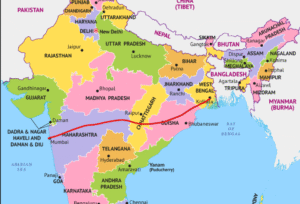
- 2. Major cities and connecting lines between them, for instance, if you travel from Mumbai to Kolkata, what is the minimum number of states that you must pass? See map below.
- 3. Major lines such as Tropic of Cancer and Standard Meridian line and the states/major cities passing through them, for instance what cities lie very close to the Tropic of Cancer? Answers include Ahmedabad, Ujjain, Bhopal, Jabalpur, Shahdol etc. Or the Ten degree channel passes through?
- 4. North-south and east-west order of major cities/region/places/locations of interests/pilgrimage sites and the region where they are located in, for instance, Tirupati is located in Seshachalam hills, or what is the correct order from North to South of Hyderabad, Panaji and Amaravati (see map above)?
2. Study World map by separating it region wise
- Take a good look at the World map to get yourself familiar with the major regions: Asia (focus on South Asia, South-east Asia, West Asia, East Asia and Central Asia), Europe, North America, South America, Australasia, Africa, Arctic and Antarctica.
- Study these regions separately. Only one map (including both political and physical features) should be enough.
- What to study in regional maps:
- 1. Major oceans, rivers, their borders with nations and the channels/straits/navigation lines passing through them, for instance, what nations are bordered by Black Sea or Caspian Sea? What channel/canal connects the Red Sea to the Mediterranean Sea? Where is the Strait of Malacca located or it passes via which of these countries? Order of Yellow river, Yangtze river etc. in the map? Or Ocean currents such as Gulf Stream, West Drift, Kuroshio current etc.
- 2. International borders of countries and whether they are landlocked or not, for instance, what are the landlocked countries in Africa and Central Asia? Or what countries border Syria? Is Syria/Jordan/Israel landlocked or not?
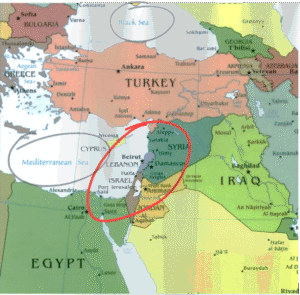 3. Major locations of interest in news, their location and their order in the map (North-South or East-West), for interest, where are Tashkent, Almaty, Gaza Strip, Cayman Islands located? Or arrange these European countries from north to south – Franc, Germany, Italy, Greece etc.
- 4. Major physical features and the regions they are located in, for instance, where are Rocky mountains, Lake Baikal, Alps, Ural Mountains etc. located? Or the Amazon or Nile river passes through which of the following countries?
- 5. Major lines and the countries passing through it– for instance, the Tropic of Cancer/Tropic of Capricorn/Equator passes through which countries?
- 6. Major biodiversity hotspots and conversation areas across the World, for instance, Ross Sea in Antarctica, Indo-Burmese hotspot, Madagascar and the Indian Ocean Islands etc.
- 7. Major international projects and the countries they involve, for instance, International North-South Transport Corridor, Ram Setu project, Kaladan Multimodal project, Chahbahar port project, String of Pearls etc.
3. Keep referring to maps to better grasp events
- • When you come across a major place in news, immediately look it up in the map (or internet) to see its location, for instance, Herat in Afghanistan .
• This will not only lead to a better memory of these places, but also help you grasp the news better because you can visualize it. You also learn the map gradually but surely.
• Notice if the location of the region is of geo-political significance, especially focus on the Middle-eastern region and the Central/Southern Asian region.
• When reading NCERTs, try to learn the following maps by heart: cropping pattern maps, soil maps, seismic maps, old Ancient/Medieval maps of Kingdoms This will also help you enrich your answers in UPSC Mains questions. - 4. Solve past year UPSC map questions and mocks to do better
- • Almost every year 2-3 questions are asked from maps.
• Solve map based questions asked in last 10 years and notice the kind of questions asked. Focus on those areas when studying a map. You will notice that a vast majority of questions fit in the specific categories mentioned above.
• Then, solve lots of mock tests where map based questions are asked. For instance, in 2024 test series, in each of the tests we focus on one particular region and ask a variety of map based questions so that you get used to facing them.
• Keep a World map and a map of India glued to your study desk or a wall near to you and keep referring to it for better retention. - Mastering maps requires time and gradual effort. But the efforts are rewarding and they boost your self-confidence tremendously. All the best!
Recent Comments
No comments to show.